Why I made a 67-page binder for young people in foster care — and what I hope it gives them.
There’s a moment I have watched more times than I can count.
A teenager arrives. Sometimes with a duffel bag, often with a trash bag, occasionally with almost nothing at all. And somewhere in that first week, an adult asks them a question about their own life.
When was your last tetanus shot? What was the name of the school before this one? Do you have your Social Security card, or does your worker have it?
And they don’t know.
Not because they weren’t listening. Not because they don’t care. Because the answer has never once been theirs to hold.
The strange arithmetic of a documented life
Here is something I don’t think people outside this system fully understand: a child in foster care is one of the most thoroughly documented people you will ever meet.
There is a county file. An agency file. A court docket. A medical chart, a school cumulative folder, a treatment plan, a service plan, a visitation log. Adults sit in rooms and discuss the details of this young person’s life with real care and real attention.
And the young person at the center of all of it walks out of that meeting with a backpack and a phone.
Their history exists. It is simply held by everyone except them.
I spent twelve years as a foster mom, and for part of that time I sat on the other side of the table too — teaching pre-service classes, and working on staff at an agency, walking through family homes and helping place children into them. I have seen this from nearly every seat. And the pattern I kept noticing with our teenagers was not that people didn’t care about them. It was that their own life story had become something they received secondhand.
What I watched our teenagers carry
We fostered several teens over those years, and the thing that stayed with me was how much they moved.
Not always because something went wrong. Sometimes a placement ended well. Sometimes a family situation shifted, or a sibling group needed to be together, or a case plan changed. But the effect on a sixteen-year-old is the same either way: another bedroom, another set of adults who don’t know your history, another intake form asking questions you’ve answered a dozen times.
Each move meant starting over as a stranger in your own life.
And every time, something got lost. Not always something big. A certificate from a class they finished. The name of the coach who actually got through to them. The doctor who knew about their asthma. The address of the house where they were happy for eight months. Small things, and then more small things, until a person is seventeen and can’t reconstruct their own timeline.
Teenagers notice this. They notice it more than we think. And what they usually conclude — quietly, and mostly without saying it out loud — is that their life is something that happens to them rather than something that belongs to them.
That is the thing I wanted to push back against.
So I made them a binder
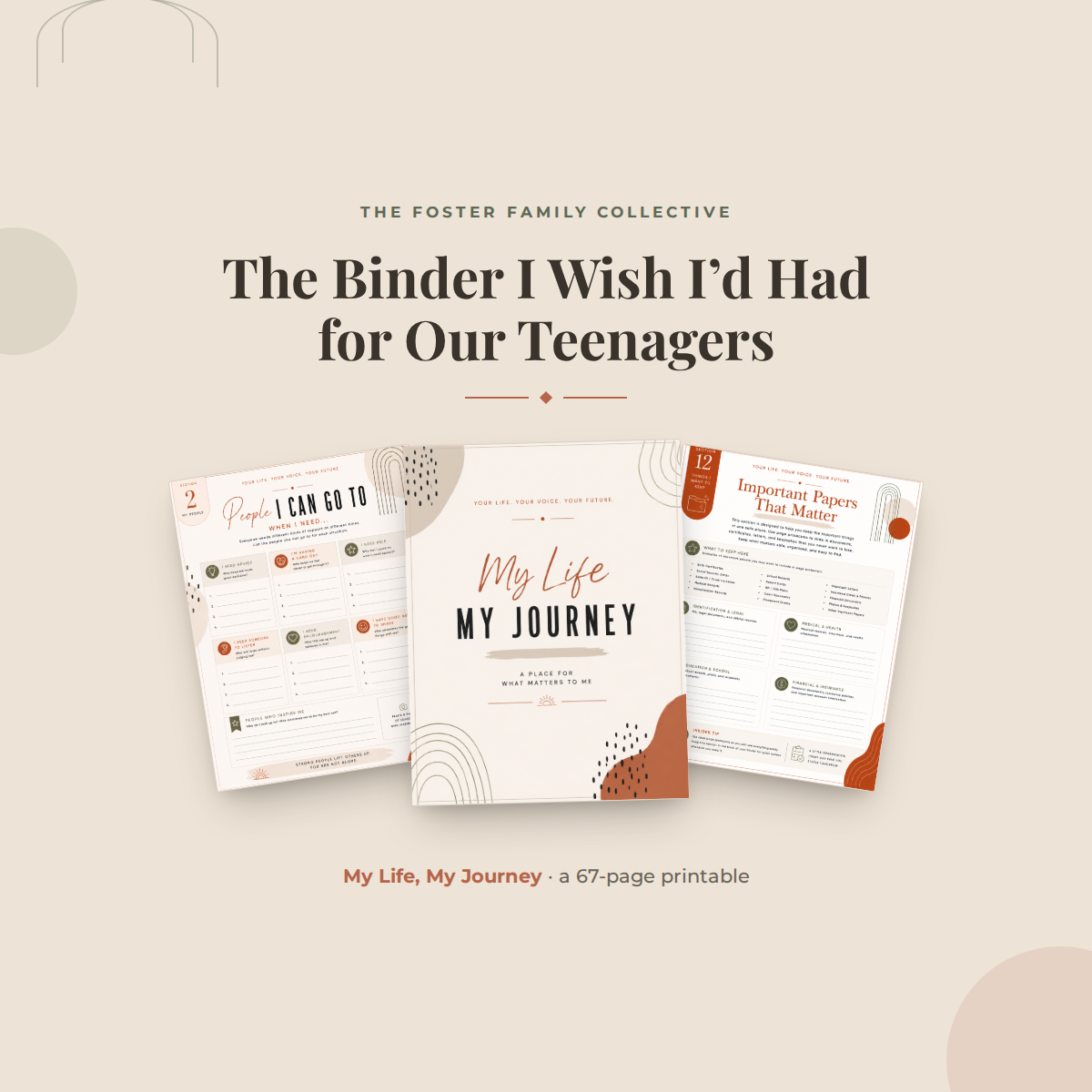
It’s called My Life, My Journey, and the line across the top of every page is your life, your voice, your future.
It is 67 pages, and it is not a case file. It’s not for the agency, or the court, or the next placement meeting. It belongs entirely to the young person holding it.
Some of it is deeply practical. There are sections for health information and health history, appointments, and a medication log. Sections for personal documents — an ID checklist, insurance information, important numbers, and a place to write down where each document actually is and who has it. School history, classes, teachers, grades, IEP or 504 information, activities and awards. Money and life skills: bank information, savings goals, jobs, resume notes, the steps toward a driver’s license.
These pages matter enormously, and they matter most at eighteen. A young person preparing to age out needs to be able to put their hands on their own birth certificate, their own immunization record, their own school transcript. Building that habit at fifteen is not paperwork. It’s preparation for independence.
But the binder is not only administrative, because a life is not only administrative.
There is a section called This Is Me — favorites, things I’m good at, routines, goals. My People: the people who matter, the ones I can go to, the ones who inspire me. My Stuff, which includes a checklist for when I move, because I have watched too many teenagers lose belongings in transitions that no one meant to be careless. Where I Live, with room to write down what actually helps this house feel like home.
There’s My Journey — places I’ve lived, a placement timeline, schools I’ve attended, important life events, and a page titled people I never want to lose.
There’s My Rights & My Voice, which might be my favorite section in the whole thing. Space for questions they have, notes from meetings held about them, the decisions that affect them, who they can talk to, and how to get help. Because a teenager who can walk into a meeting with written questions is a teenager who is participating in their own life rather than being processed through it.
And there’s Things I Want to Keep. Photos, cards and letters, certificates, keepsakes, journal pages, blank notes.
The last line of the binder reads: This is my story. And it’s still being written.
How to actually give it to a teenager
One thing I’d ask, if you bring this into your home: give it to them, and then let it be theirs.
The instinct — and it’s a loving instinct — is to fill it out for them. To sit down with the medical records and get it organized properly, because you’re the adult and you have the information and you want to be helpful.
Please don’t. The entire point is ownership, and ownership you didn’t choose isn’t ownership.
Offer to help. Sit nearby with the immunization record and let them write. Answer questions when they ask. But let them decide what goes in it, what stays blank, and who gets to see it. A teenager who chooses to leave twenty pages empty has still received the message that their life is theirs to author.
And know that some pages will be harder than others. The placement timeline can be a hard page. So can people I never want to lose. Let them skip anything they want to skip, and come back in a year, or never. Print only what they need — it’s a printable, so you can start with ten pages instead of sixty-seven if that’s the gentler beginning.
What I hope it does
I don’t think a binder fixes anything. I want to be honest about that. It doesn’t shorten a case, or bring a family back together, or undo the number of times a young person has packed a bag.
But I do think there’s something quietly powerful about a person being able to hold their own record. To answer a question about themselves without waiting for an adult to look it up. To arrive at a new house and not arrive empty.
Our teenagers deserved something like this. I just didn’t know how to make it yet.
The Foster Teen Binder — My Life, My Journey is a 67-page printable, available now in The Foster Family Collective shop.
67 pages · US Letter · instant digital download · print only the pages you need
Leave a Reply